

Boyd Davis, Co-founder, Payfederate®
TL;DR
The market for salary benchmark data has multiplied — traditional surveys, aggregators, job postings, offers data, employee-reported platforms — and most organizations are still buying it the way they did a decade ago. Modern salary benchmarking means treating market data as a governed process, not an annual purchase order.
I’ve lost count of how many budget reviews start the same way: someone pulls up the vendor list for compensation data spend and realizes nobody can say, with a straight face, which survey is actually driving pay decisions anymore. Two or three subscriptions covering nearly identical job families, renewed on autopilot, year after year, because switching or consolidating always feels riskier than just paying the invoice again.
That pattern is more common than most C-suite leaders would guess. Salary benchmarking used to mean picking one survey provider, submitting your incumbent data once a year, and waiting for a report.
Today, building a sound compensation benchmarking strategy means navigating a market that includes legacy consulting surveys, data aggregators, real-time job-posting feeds, offer-based data, and employee-reported platforms — often all at once, purchased by different people, for different reasons, with no shared governance.
Getting salary benchmarking right in 2026 isn’t about finding the “best” provider. It’s about building a purchasing and usage strategy that survives vendor changes, catches bad data before it reaches a pay decision, and blends sources instead of betting the entire compensation benchmarking function on one
The Market Got Crowded Before Anyone Redesigned the Process
For decades, salary survey data came from a small handful of names — Mercer, WTW, Radford, — and the buying process was simple because the market was simple. That’s no longer the case.
Real-time job-board data, self-reported salary platforms, and offer-tracking tools have all entered the compensation benchmarking conversation, usually positioned as faster, cheaper alternatives to the legacy players.
They’re not replacements. They’re additional inputs. Treating any single source — old or new — as the whole answer is where most of the risk in a modern salary market analysis actually lives.
Best Practice One: Decouple Your Process From Any Single Data Source
Every salary survey you buy is, in practice, a vendor-specific benchmark. It comes bundled with that provider’s job codes, matching methodology, and update schedule. Wire your job architecture and market pricing logic directly to one provider’s structure, and switching vendors — or simply adding a second source — turns into a multi-quarter rebuild instead of a configuration change.
A few things that make this decoupling real rather than aspirational:
- Keep your own job architecture and level definitions as the system of record; treat every survey as a mapped input, not the foundation itself
- Build or buy a matching layer that can translate your roles into any vendor’s job codes, not only the one you use today
- Make sure you can renegotiate, add, or drop a provider without re-benchmarking your entire organization from scratch
The single biggest mistake I see compensation teams make is designing their entire market pricing process around the assumptions of whichever survey they happened to buy first. That decision quietly becomes permanent, long after the reasoning behind it is forgotten.
Best Practice Two: Use Multiple Surveys, Not Just One
This is one of the more well-documented realities of compensation benchmarking, and the data backs it up. A 2024 CompTool survey of more than 500 HR and compensation professionals found that only about one in five organizations rely on a single salary survey data source.
Roughly three-quarters use two or three sources per job, and companies with a dedicated market pricing tool subscribe to noticeably more surveys on average than those managing the process manually.
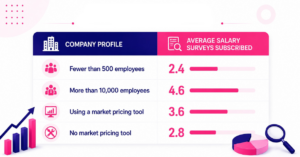
Source: CompTool, Salary Benchmarking Best Practices Survey, 2024
The logic holds up, and it keeps your salary market analysis grounded in more than one vendor’s point of view: no single survey covers every role, industry cut, and geography with equal rigor. Blending sources smooths out the gaps — a thin sample size in a niche job family, weak coverage in a specific market, one provider’s particular quirks in how they collect compensation data. The tradeoff is added complexity, which is exactly why the process needs to be decoupled from any one vendor in the first place.
Best Practice Three: Monitor Usage Like You Would Any Major Contract
Salary survey subscriptions routinely run $10,000 to $30,000 a year per source, and larger enterprises subscribing to four or more surveys are easily spending six figures annually on compensation data. Very few organizations can say, with real confidence, which surveys actively inform pay decisions and which are renewed out of habit.
- Track which surveys actually get cited in market pricing decisions, not just which ones get purchased
- Set a defined review cadence — A strong plurality of organizations validate their market matches roughly every 12 months, which tends to line up with typical survey refresh cycles
- Flag overlapping coverage before renewal season arrives, not after the invoice does
This is the least glamorous best practice on this list, and the one most often skipped. But an unaudited salary survey data budget is one of the easiest six-figure line items to quietly overspend, year after year, without anyone noticing.
Best Practice Four: Apply Alternative Data Sources Carefully
Not all compensation data is built the same way, and treating it as if it were is where a lot of salary benchmarking programs get into trouble.
It helps to separate the market into two broad categories: survey data, which is collected directly from participating employers through a structured process, and derived data, which is modeled or aggregated from public records, job postings, HRIS feeds, or accepted offers rather than submitted by employers directly.
Both have a place in a modern compensation benchmarking strategy. Neither should be used blind.
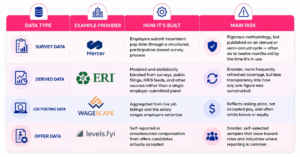
Used well, this distinction sharpens a salary market analysis considerably — derived data and job-posting data can flag where the market has moved faster than your last survey cycle, and offer data can validate whether your ranges are actually winning candidates. Used carelessly, they introduce a different kind of noise: an advertised range is a starting position, not a settled salary, and a modeled estimate is only as good as the inputs behind it.
Treat derived data as a directional check against your primary compensation data, not a wholesale replacement for it.
Building a Salary Benchmarking Strategy That Survives the Next Vendor Change
None of these four practices works in isolation.
A market pricing process that isn’t decoupled from its data source can’t meaningfully use multiple surveys. A budget nobody monitors will keep paying for redundant subscriptions. And alternative data applied without discipline just adds one more uncoordinated input to a process that’s already fragmented.
At Payfederate, this is precisely the problem our market pricing module was built to solve: compensation data from multiple surveys, blended and matched inside the same environment where your job architecture and pay bands already live, so adding or switching a source doesn’t mean starting over.
Salary benchmarking shouldn’t be the most brittle part of your compensation strategy. With the right process behind it, it can be the most reliable one.
Explore Payfederate and see how salary benchmarking, market pricing, and compensation data from multiple sources can work together in one connected platform.