

Michael Dressler, Director of Business Development, Payfederate®
| TL;DR AI job matching and manual job matching are solving the same problem — mapping an internal role to the right benchmark job — but they fail in opposite ways. Manual matching is slow and inconsistent between analysts. AI job matching is fast and consistent, but only as sound as the logic and oversight built around it. The organizations getting more defensible market pricing today are using AI to do the matching and people to do the judgment, not asking one to replace the other. |
Market Pricing Lives or Dies on the Match, Not the Survey
Most conversations about market pricing start with the data: which survey, how many participants, how recent the cut. That’s an essential starting point — but the quality of the data only gets you so far if the job isn’t matched correctly. Two organizations can subscribe to the identical salary survey, submit the identical role, and land in two different places on the market purely because of how that role was matched to the survey’s job catalog. The survey data is fixed. The match is a judgment call, usually made under deadline pressure by someone who wrote neither job description being compared.
That single judgment call is the actual bottleneck in compensation benchmarking, which is why the choice between AI job matching and manual job matching matters more than most C-suite conversations about “comp technology” give it credit for.
How Manual Job Matching Actually Works
A survey provider’s job catalog can contain thousands of standardized benchmark jobs. Someone on the compensation team — often a generalist analyst, sometimes an outside consultant who has never met the incumbent — has to map each internal role to the closest catalog entry using job descriptions, org charts, and their own sense of “close enough.”
“Close enough” is not a throwaway phrase. It is a defined threshold, and three respected providers define it three different ways:
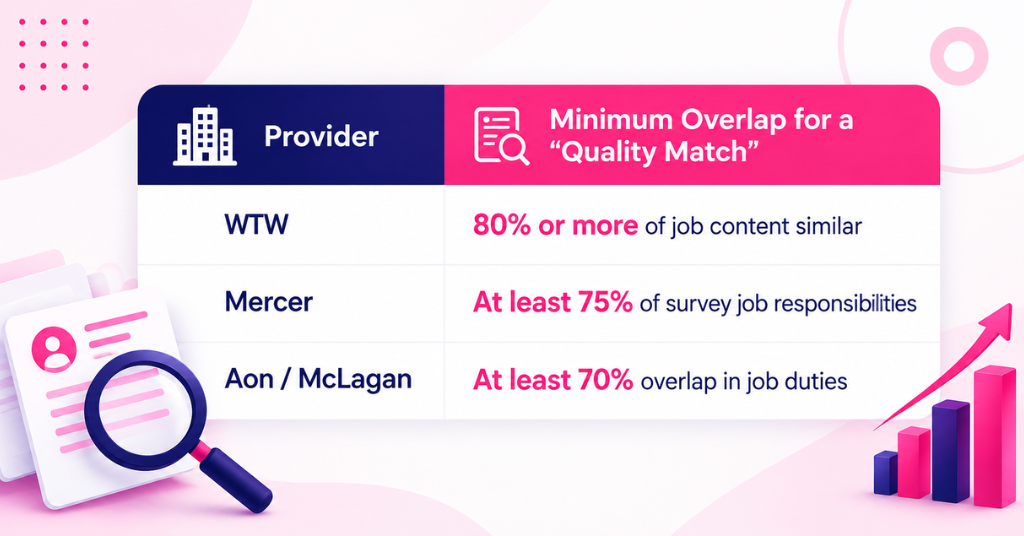
There is no universal definition of a good match. Whichever threshold an analyst is working from, they are still making a subjective call about what “similar” means for a role that rarely lines up cleanly with a catalog job — and that call gets made differently by every analyst who makes it.
Where Manual Matching Actually Breaks Down
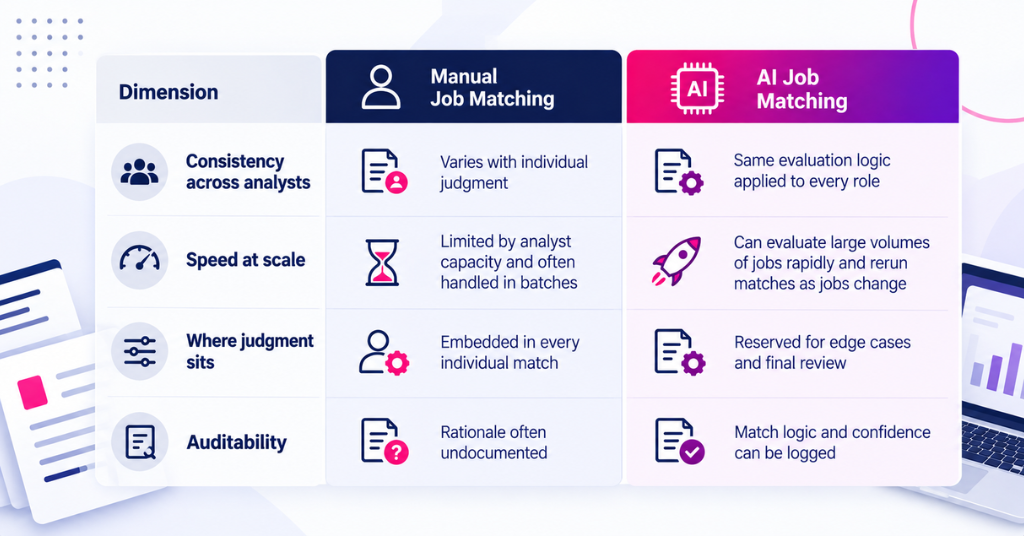
- Subjectivity at scale: Two analysts working from the same job description can reasonably land on two different benchmark codes. Across thousands of employees and hundreds of participating companies, that inconsistency becomes invisible noise sitting underneath market data that looks perfectly precise.
- Time: The entire survey submission process, driven largely by job matching, is a multi-week project for most participants, according to Mercer — which means pricing decisions are often finalized against positioning that is already months old by the time the data comes back.
What Changes When AI Does the Matching
AI job matching software approaches the same problem differently. Instead of one analyst reading one job description against one catalog entry, an AI compensation platform can evaluate a role’s full scope — responsibilities, required skills, level, reporting line — against the entire catalog at once, and apply that same evaluation logic to the next ten thousand roles it sees.
That consistency is the real gain, more than the speed. A rule applied identically ten thousand times, even an imperfect rule, produces market pricing you can explain and defend. A rule applied slightly differently by a dozen different analysts does not, regardless of how experienced each of them is individually.
None of this makes the human step optional. The organizations getting real value from job matching technology are not removing a person from the loop — they are moving that person from doing the match to reviewing it, reserved for the genuine judgment calls AI should not be trusted to make unsupervised.
The Adoption Gap Comp Teams Can’t Afford to Ignore
The appetite for this shift already exists at the top of HR. According to SHRM’s 2026 State of AI in HR report, 92% of CHROs expect greater AI integration across the workforce this year, and 87% expect deeper AI adoption specifically within HR processes. Yet the same research found that a majority of organizations have not implemented AI within the HR function itself and have no plans to in 2026.
Job matching sits squarely inside that gap. It is repetitive, high-volume, and error-prone by design — precisely the workflow AI compensation software is suited to, and precisely the task most comp teams are still doing the old way while their own CHRO tells the board that AI adoption is a priority.
Getting Ahead of It
- Ask how matches are actually generated. A model that primarily reads job titles isn’t meaningfully different from a keyword search — ask whether it evaluates full scope, level, and reporting structure.
- Ask how disagreements get resolved. Every AI job matching system will occasionally get a match wrong; what matters is whether it flags low-confidence matches for review instead of presenting every output with equal certainty.
- Ask how the underlying catalog stays current. A model is only as current as what it’s matching against — find out how new and emerging roles get incorporated, and how often.
- Pilot it side by side before switching entirely. Run twenty already-benchmarked roles through the AI process and compare; wherever the two disagree is exactly where to ask why.
- Keep a named reviewer accountable for exceptions. Job matching technology should narrow the set of judgment calls a person has to make, not eliminate the need for someone to own them.
Better Market Pricing Starts With a Better Match
The choice between AI job matching and manual job matching isn’t really about speed, though speed is real and worth having. It’s about whether the market position your organization defends to its board, its employees, and its regulators was built on a match that can be explained and repeated — or one that happened to be made by whoever was available that week.
Connect with Payfederate to see how AI-powered job matching underpins a market pricing engine built for consistency at scale, with a trial period built in from the start.